Knowledge Panels & KGMID SEO with Dennis Yu
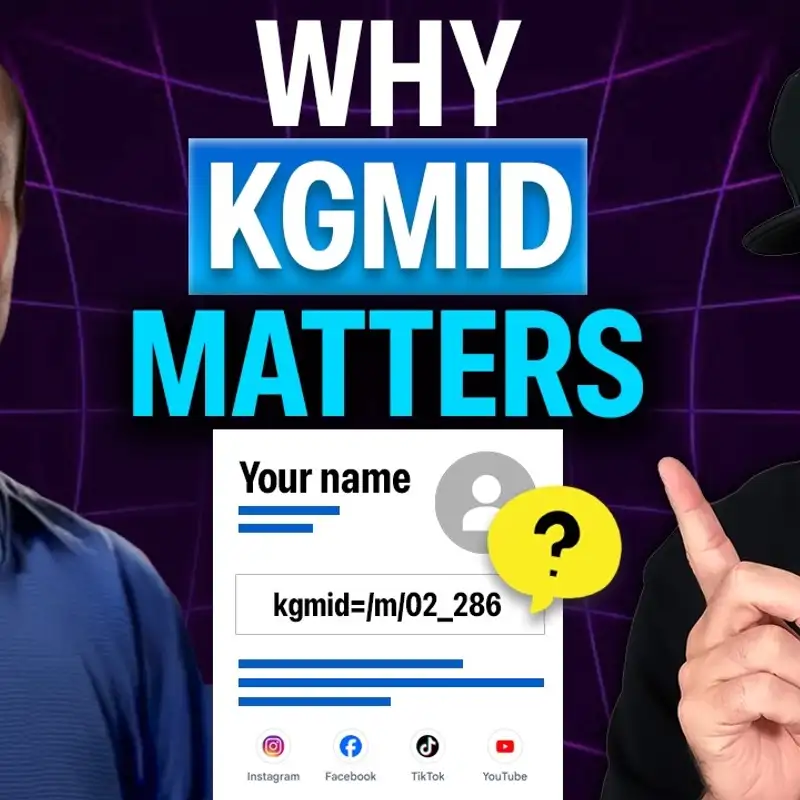
James Dooley: Google knowledge panels, getting yourself that KGM ID, also known as a knowledge graph machine ID, and the importance of it. Today I'm joined with no other but Dennis Yu, who is an absolute legend when it comes down to knowledge panels. So Dennis, first and foremost, before we start about how to trigger it and a more in depth kind of conversation, is it important initially to have a knowledge panel and why?
Dennis Yu: It is if people are going to Google your name, your company's products, your company, and you want to dominate the search results with those coloured boxes. You want to win an AI search. You want the featured snippets to show up. Then yes. If you are just somebody where you're trying to be invisible, then it does not matter. But if you're a public figure, if you're an entrepreneur, then by definition you're a public figure, and that would be important.
James Dooley: Anyone now that says, "I want to be seen in AI. I want to grow my business. I want me to be the founder that's attached to a successful business that I'm really proud of," but they do not have a knowledge panel. What are the first steps for these to try to start going, "Okay, I'm going to start now working towards getting myself a KGM ID?"
Dennis Yu: You can use Google's tool. You do not need to use anyone else's tool. Look yourself up. We built a tool too, just to show how many other James Doolies there are, to see what the competition is. Then usually you'll get a few other people. Maybe you'll be unlucky and there's like an athlete or a porn star or someone like that. But even if there is, you can still get your knowledge panel.
Dennis Yu: You have to decide what you are really known for. What have you achieved? What are you notable for? And it is not the Wikipedia notable. It's a different kind of notable. Are there citations and facts that are not from your websites, not from your social media, that show credibly that you are someone who is worth listening to about a particular topic or having achieved a certain result. That should tie with your why. That should tie with the reason why you started your business. If you're an entrepreneur, that should tie with the expertise that you have.
Dennis Yu: Most people do not have the footprint of all the social media. They do not have a personal brand site. They do not have schema on the company site and the personal brand site. Their company about is really their personal about. They have all this confusion, which creates disambiguation. But if you get that basic layer sorted out, which literally schema with WordPress takes care of half of that, then get on other people's podcasts. Interview other people that you think should be notable, or are notable, in the area that you want to be known for.
Dennis Yu: Take those podcast episodes and those each become a chapter in a book, and you can use your favourite AI to turn it into a book. Put it on Amazon. Have the print and Kindle copies. Put a dollar a day against it. Make it a bestseller. Take a screenshot showing your bestseller. Then it's driving traffic. You repurposed all those podcast episodes to YouTube and now you have this virtuous circle.
Dennis Yu: No matter where Google is looking, they look on social media, they look at Groipedia, which is sort of its own little thing, they look at X, they look at Facebook, they look at people's blogs, and all of those corroborate. Yes, this is James Dooley.
James Dooley: With regards to that, there's quite a lot of stuff in there that needs to unfold a little bit. So you're talking about disambiguation. For anyone who's listening to this that is not familiar, obviously it's a very well-known term used within the knowledge panels. Can you just explain what disambiguation means between different kind of people with the same name and stuff like that?
Dennis Yu: You want to show that you are distinct. If there's this John Smith and this John Smith, how do we know that it's the same John Smith? Maybe you have a business name, ABC Plumbing. How many other ABC Plumbings are there? That's when you go down to the facts of the name, address, and phone. That's when you go down to the other entities that are attached to that particular company or that particular person.
Dennis Yu: If you think about that entity, how clear is that entity? So the entity could be a person, a place, whatever company. But we say James Dooley, let's say, is a person. That entity, what are the facts about that entity? What was your date of birth? Who are your relatives? What books have you written? What companies are you involved in? What are all the facts that detective Google would find in researching you?
Dennis Yu: A lot of people, because of the way they do hypertext, or because they create pages the wrong way, or because they do not have a personal brand website, and they use their company about, all of those things create confusion. Disambiguation is just a fancy way of saying reduce the confusion, so we have clarity on information tied to each particular entity, and then how those entities are connected. If that structure is set up properly, including all the social medias for each of the names, and then that information is connected together, then it sends a very clear signal and Google can be very sure. Yes, this is James Dooley. Yes, this is Dennis.
James Dooley: That leads me on to the next question because you said about connecting the entities together, right? You mentioned earlier about getting a personal branded website. So for me it's like jamesdooley.com. Some people call it different things. Some people call it the entity hub, the brand hub, whatever it is. That's the central source of who you are and what you do. Then you said about getting schema with the same as and linking it to your social profiles and stuff like that.
James Dooley: Pretty much everyone should have a Twitter, a Facebook, a YouTube and all the basics and linking through to it. You speak about the dollar a day amplification. If anyone does not know what it is, check out the link in the description which kind of builds up the popularity. But you mentioned podcasts.
James Dooley: If you're on this podcast now, would you on your own entity hub go and do a post about this podcast and then wrap that in schema? Or do you just wrap it in schema just on one podcast page for all the different podcasts? Or each individual podcast do you go and then do a dedicated URL and link to that podcast? You've been listening to Jason Barnard because that's what he would say. One page for each of these that all linked together. But when you look at that, it looks like someone is designing that for the robot.
James Dooley: I get it. You want to have subject, verb, direct object. You want to categorise everything the right way. In an ideal world, yes. But practically speaking?
Dennis Yu: If you have a relationship and there's proof of it, like you and I have done multiple podcast episodes and that's distributed on blog posts on YouTube. YouTubes are embedded inside the blog posts and we use schema to identify the objects that are within that page. Yes, if it's an important object then we'll have a whole page for it, and it ties to other related topics and objects.
Dennis Yu: All the things that you would do as SEO, you would do that. But literally it's as simple as saying, what of all the different things I want to be known for, of all the people that I know, can I prioritise the top two or three topics, the top two or three people I want to be associated with, and is there long form content like a podcast episode.
Dennis Yu: I like podcasting as a hack because I only need to sit down with someone once or twice and then I've got content for days. That enhances their ability to show up on Google. My stuff will show up in their knowledge panel and vice versa.
Dennis Yu: My favourite part of the knowledge panel is not when people look for you, because if you Google my name you'll see the knowledge panel and all that. But when you look at Neil Patel or Mari Smith or other people that are well known in digital marketing, it'll also say people also look at Dennis Yu and these other people. That's when you know. When you're connected to these other people, you speak together, you tag them on Facebook but not in an annoying way, you reference them by saying here's one thing that Gary Vaynerchuk told me, and you show a picture of you and Gary Vaynerchuk.
Dennis Yu: That shows that you are credible. I'm not even doing it for Google. I'm doing it because it shows the audience that you're credible.
James Dooley: That notability and credibility, does that then with someone types in Neil Patel and you got people also search for, is there any other ways of getting in there? Or does it just come down to how much noise you have together and the connections together? Or is it related to people search for Neil Patel and then they've gone and searched for Dennis Yu for example?
Dennis Yu: It's when people consume Neil Patel's content, people consume my content, and that's a Venn diagram and there's that overlap. That's what Google's looking at.
Dennis Yu: Just like with YouTube. I was in Turkey last month. Go back, research ancient civilisations, the stuff that's 6,000 years older than the pyramids, and it'll start showing me stuff that not only is related to Graham Hancock who talked about that, but also on that topic. Consider what are the topics you want to be known for so you can be recommended in ChatGPT or YouTube or whatever. Also consider who are the people. The intersection of people and topics is where that sweet spot is. Then you do a podcast with a couple of those people and you've hit the bullseye.
James Dooley: We've spoke about video format and podcasting. Does Google Images ranking in Google Images have any sort of impact in improving your knowledge panel or not?
Dennis Yu: It does. But remember, when you have a podcast or a video with somebody, you can pull images out of that.
James Dooley: Yeah.
Dennis Yu: Once you have a knowledge panel, you can go in and edit it and choose which pictures you want, or correct information and whatnot. More common, folks like you and me will have duplicate knowledge panels and then we'll try to merge them together. That whole messy thing of trying to consolidate, disambiguate down into one.
James Dooley: What about Google Scholar? Do you do anything with Google Scholar to try?
Dennis Yu: That's great for books. There's many other places you can publish this. If you've done anything in terms of academic publications, which is not the same thing as self-publishing on Amazon, that does carry more weight. It's kind of like an edu link versus a.com link.
James Dooley: And with regards to the books, do you always publish it on Google Books as well? Because it seems to strengthen up. It seems to pull in that as being one of the bio descriptions in knowledge panels. Do you publish it, or do you only publish to Amazon?
Dennis Yu: In an ideal world, you publish to all of these. We would think that Google would be biased towards their own source. They'd be biased to YouTube and Google Maps and things like that.
James Dooley: With regards to the book you mentioned in there, bestseller, how are you looking to get the bestseller for the book? Is that you using the amplification of a dollar a day strategy?
Dennis Yu: Yeah, in our other episode, we talked about dollar a day. So if you have interviewed someone on your podcast who is well known and has the depth of expertise that you want to be associated with, and then that gets turned into a book, which is very easy to do using your favourite AI tool, and you publish that to Amazon, and then you interview 10 people.
Dennis Yu: Then you send out that book to all of those 10 people and now they're co-authors and now they're sharing that. "I'm so excited to be in James Dooley's book. I'm in chapter three." Now all of a sudden they're all sharing that book, which ties to that entity. That's an object tied to you. You're another object as a person. You're creating these third-party signals, which in a technical way improves your personal brand.
Dennis Yu: Then when you run dollar a day ads on Amazon, maybe put like $5 a day, but you only spend like $150. You can choose up to three categories. When you become a bestseller in one category, it's actually very easy. You take a screenshot of that. Google can see that. Amazon can see that. There's actual traffic. People like your book. Hopefully you get some good reviews. If your book is good, then you're showing real behavioural signals, which is ultimately what we want to show.
James Dooley: Any specific choice of category that you go for? Because I'm presuming if you just went marketing in general, it'd be hard to get best.
Dennis Yu: This is the whole niche. What niche do you want your business to be in? I have a friend, Jabez Labret, and he wrote arguably the book on legal digital marketing for lawyers. He went and spoke at all the big conferences. He would bring his book, he says, and he would advertise that he was at the conference. He'd say, "I'm the number one bestseller in digital marketing for lawyers."
Dennis Yu: Then he told me, because I said really, he said, "Don't tell anyone. I only sold seven copies of my book." How many other people have produced a book on digital marketing for lawyers?
Dennis Yu: My buddy Danny Librandt, you probably see me and him do a bunch of stuff. He started out of nowhere three years ago and he chose the super niche of the super super niche of SEO for pest control companies. James, how many other people do you know that are experts for SEO for pest control companies?
James Dooley: Yeah.
Dennis Yu: He interviewed all the top people in pest control. Some of these guys have $50 million a year companies. He went to the conferences. He's interviewed the Neil Patels of the world. Anyone who's even sort of connected with pest control, now he has ownership in a pest control company, a pest control agency. He speaks at PestWorld. He's at all these pest podcasts. Everyone in the world of pest control knows who he is. He's a celebrity when he walks around the conference because he chose that.
Dennis Yu: But he did the podcast thing, turned it into a book, gave out copies of the book, set up a table. People come up, they love to take pictures and autograph copies with him as the author. All of those things multiply together and then of course run ads, free plus shipping, use it to sell your course or your coaching programme or whatnot, or give away your book. All that.
James Dooley: Let's say someone's done all that. Let's say someone's watching this episode and they're saying, "I've got my books. I've got lots of videos out there. I'm promoting it on social media. I'm doing the dollar a day strategy and stuff like that." And there's three really powerful Dennis Yus. There's a porn star, there's a sports player, and there's yourself. When you type it in, your name is not coming up. Them other two are.
James Dooley: Apart from the amplification on socials, is there any third party sources that someone could be watching this saying you need to be doing this, this, this, this, this, and this. I'm not saying it's a one-size-fits-all, but is there any really trusted sources that you think. I do not just mean go and get yourself a Wikipedia page because you might not have the notability yet.
James Dooley: I've seen you talk about Groipedia, saying go and get yourself in there. Is there any other sources that people could as a key takeaway say go and get these. They're pretty simple to get and they will improve the clarity and confidence with who you are and what you do, which might take you on to the next stage.
Dennis Yu: You could publish that book cross-publish, which is fine, on free-ebooks.net, which has been around forever. I'm an owner in it. It's got a domain rating 75. We have half a million visits a day coming organically from Google. So you're coming from the UK, you type in free ebooks, I'm number one.
Dennis Yu: But here's the other thing. If there's two, you know, there's a porn star and an athlete or whatever with my same name, maybe that porn star is in India and I'm not trying to rank in India. What I'm trying to do is show up for the audience I want to reach and Google's smart enough to know when someone's looking for Dennis Yu and they're in home services or they're in local, Google knows to show me.
Dennis Yu: There is a Dennis Yu Hong Kong film director because Yu is a two-letter last name, super common. It's like Smith. So, if you're in Hong Kong and you type in Dennis Yu, you'll probably get that guy who's a famous film director. Context is important. I don't want to try to rank for Dennis Yu everywhere all the time. It matters to this idea of when do you need to show up when there's business value to you.
James Dooley: I've seen you've done a video on the free ebooks, have you?
Dennis Yu: Yeah.
James Dooley: If there is, send it me through. I'll put the link in the description to anyone who's looking at it. I think you've got a whole strategy around how you should be sending that out.
Dennis Yu: I'll do this for you, James. You've got what, 280 episodes or something like that. You've got so much content. If you want to package that up into a book and follow our article guide, our book guidelines, which are pretty straightforward, I'm the publisher. So I will publish it. I will feature your book. I will link to you from many, many places. You could not even buy links of that quality.
James Dooley: Yeah.
Dennis Yu: I'll do that for you because I want you to see.
James Dooley: I published eight, I don't know if you know this or not, but last year I published eight books. They're on Amazon, they're on Google Books and stuff like eight different books that I sent out. I did a similar strategy. I never heard you talking about this previously. I did a similar strategy where I went and got I think it was like 47 influencers in the SEO space and I did one which is like advanced SEO tips and I got all them to write a chapter each and syndicated it out. I went and bought I think it was like 500 copies and gave it out at certain events and stuff like that.
James Dooley: The amount of exposure that others got from it and stuff like that was incredible. But I did not do the free ebooks and if I'm being honest with you it was painful doing it writing because it was having to check it all. A lot of people's coming back with AI content and I was having to change, and it became hard work doing it.
James Dooley: This year I've gone, I'm going to go very aggressive on the podcasting circuit. So I've launched eight different podcast series and I'm going to go very aggressive on podcasting this year where last year it was books. This year is going to be podcasting. But I do not know if you can do any of the existing books. We can talk off air about this, but yeah, some of the existing books I have. Could that get syndicated out to the free ebooks and stuff?
Dennis Yu: I'm a big fan of starting with real podcast content like you and I having a real conversation, because I'm just one of those, I assume that people are guilty until proven innocent. I just assume it's AI content if it's a submission. I need to see that you and me or whoever are actually talking face to face.
Dennis Yu: I'm trying to prove to the AI beyond the shadow of a doubt that this is not AI generated, which is why I want to see you. I'll fly out to Manchester later this year. We'll record a whole bunch of these all at once to show that this is real. We'll even live stream it to prove this was real.
James Dooley: Let's do it. I'm more than up for it. We can do a whole playlist about what we did, why we did it, and so on. I think it'll be incredible.
James Dooley: Anyone who's watching this with regards to knowledge panels, is there anything else that we've missed there about specifically knowledge panels, improving KGM IDs, that people watching this are like, "Okay, I need to now take this to the next level." I understand from a previous video I've watched, personal branding is not ego, it's risk management. You need to be doing it if you're wanting to grow business and wanting to be the entrepreneur. You need that personal brand, you need that knowledge panel. Is there anything else as a key takeaway that you think the users should know?
Dennis Yu: Clearly if you're watching this, you want to get a knowledge panel or you want to get a stronger knowledge panel. But consider this. If you are podcasting with other people who will all say yes, believe it or not, even if they're big deal, and they have a knowledge panel, they're notable, they have authority and credibility, then you by interviewing them actually enhance their knowledge panel.
Dennis Yu: Then by associating with them, when people look up their name, it might also show you. In the same way your personal brand is what other people have to say about you, the best way for you to build your knowledge panel is to honour all these other people in your industry and they even could be a competitor.
James Dooley: Incredible advice there, Dennis. Dennis, it's been an absolute pleasure. If anyone wants to know any more about knowledge panels, comment down below. Dennis has agreed that he will do any other videos to discuss whatever you're struggling with. Whether you want to know specifics of triggering a KGM ID and triggering that knowledge panel. Let's say you've got one and you want it strengthening. Dennis can go into depth. He's previously a search engineer. He knows all the ins and outs related to knowledge panels. Make sure you like and make sure you drop a comment in. Dennis, it's been an absolute pleasure.
Dennis Yu: Thank you, James.
Creators and Guests